
I was strolling through Khan el-Khalili Bazaar in the Egyptian capital city of Cairo; packed with hawkers, shopkeepers, tourists and locals. Among souvenirs of unimaginable variety, my eyes fell on this Cezve. The unique design – a brass tumbler with decorative embossing and an attached rounded wooden handle. I fell in love with it. Even though I had many other coffee brewers at home, I got instant alignment from fellow coffee lover my wife. That’s how I became the proud owner of the unbranded handmade cezve. I was imagining myself pouring Turkish coffee with flair.
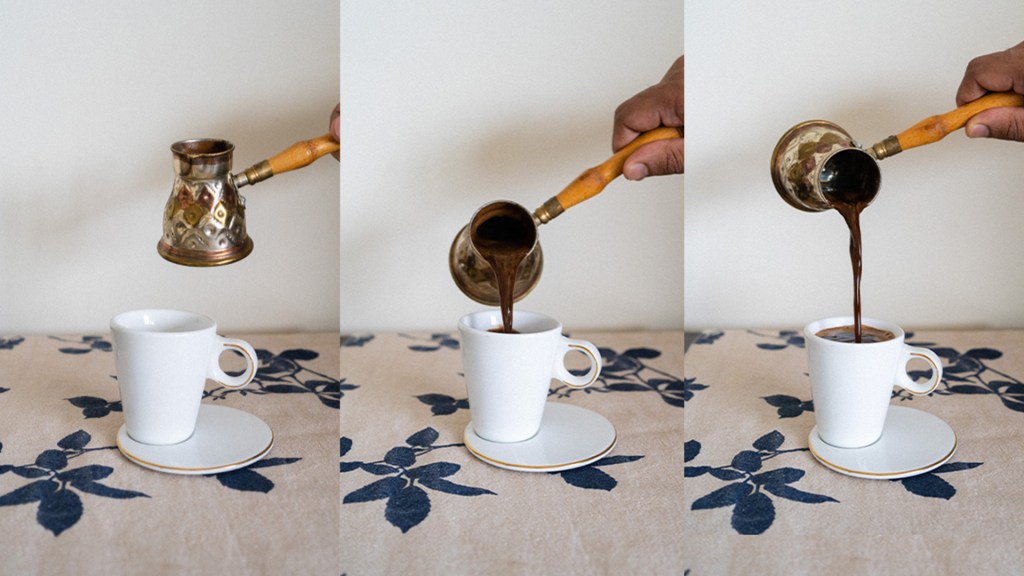
Sadly, I didn’t brew with it for more than 4 years since I got it. Turkish coffee recipe needs a very fine ground of coffee, and I have been hesitating to order a pack of pre-grounded coffee as I was so used to grinding fresh. Then, by virtue of a fortunate mistake, I ordered a very fine pre-ground coffee from Araku, that suits their design of moka pot. While initially my heart sank as I opened the pack, a eureka moment took over that it’s apt for the Cezve. Since then, I started brewing and enjoying it.
Why do I love Cezve?
Compared to the hoard of many other coffee brewers – Cezve is super fast, super simple, very intuitive, and hence a lot of fun. Cleaning is super quick too. It’s my go to early morning brew.
The Equipment
What is Cezve / Ibrik?
- The Equipment. Cezve (pronounced jez-veh) is a small long-handled pot with a pouring lip designed specifically to make Turkish coffee. It is traditionally made of brass or copper. It is also called Ibrik, Briki, a few other names. (Thanks Wikipedia).
- The Pitch. Probably the world’s oldest coffee-brewing method, and the most widely used one too.
- The Genesis. Brewing with Cezve seems to originate somewhere around 1600 AD in the middle-east Ottoman empire. There’s a huge history and cultural context for Turkish coffee which I am not covering here.
- Variants: It is traditionally made of Brass or Copper, also Silver and Gold editions for the richer folks. Nowadays, you can find stainless steel varieties as well.
- The Brew Method. Immersion Brewing.
- The Output. The coffee is served along with all the coffee fines (no filter), allowing them to settle before consumption. It’s a rich and satisfying cup, with a strength between an americano and an espresso.
Brewing Guides
What is my style? My favourite is to brew it based on the colour and motion of foam. The coffee needs to brew on low heat for ~1.5-2 minutes. Experts say 2-4 mins based on whom you ask. It needs to stop after coffee foams up and the foam starts folding on itself. The foam needs to hit a darker shade of brown as well. If timed well, both will happen together. Note that we shouldn’t be continuing to boil after it foamed for the first time, this is to prevent over extraction and bitter coffee. Brewing it too soon, especially if the heat is high, will leave the coffee under extracted. I studied a few recipes and the links to them later in the article. Here is my recommendation:
- The Roast. Medium roasts. You can use lighter or darker roasts too.
- The Ratio. I use 1:10, you can start from here and change as you prefer.
- The Dose. 8 grams of coffee, this is based on the brew ratio 1:10 and my Cezve’s capacity .
- The Grind. Very fine size, even smaller than espresso. I don’t have a fine grinder at this point, so I directly order pre-ground turkish (or very fine grind) coffee.
- The Water. 80 grams, at 60-80 degree celsius. Room temperature water makes the coffee clump together.
- The Process.
- Fill the cezve with 80 grams of hot water. Add 8 grams of coffee on it using a small spoon. I find it easier to do it in this sequence, the other way around should be alright as well.
- Mix the coffee well with the water by stirring the spoon.
- I use a gas stove, which I put on the lowest heat. As the water is already hot when I start, it gets to foam very soon. Brewing it too early will lead to under extracted coffee. So I hold the Cezve about 6 inches over the flame to reduce the heat further and extend the brew to about 1.5-2 mins.
- When it’s ready, the coffee starts foaming, and the foam starts to fold on itself, or outwards on the wall (based on the shape and size of the cezve). Colour of the foam turns darker.
- At this point, remove the coffee from heat and pour it in the cup to serve.
- The Coffee.
- Wait for a minute or two to let the coffee cool and for the coffee particles to settle to the bottom. The foam on top of the cup can contain some particles as well, which can be removed with a spoon like done for cupping. Alternately, you can just blow the foam away and start sipping from one side. It works just fine for me.
- Enjoy the rich smooth coffee.
- Be mindful. Stop before you sip on the mud. :).
Occasionally, the coffee is brewed with some sugar and served with a glass of water and sweet treats.
Here are some of the guides I tested and learned from:
- The Guru. Thomas Green’s Make Turkish Coffee Like A Boss guide is the best one to start with. He brews & explains like a master.
- The Re-Inventor. Viacheslav Druzhyin “The man who reinvented Turkish Coffee” has made this amazing video. Claims aside, I really loved this guidance on Taste Control based on Colour and Motion of the foam. This is the intuitive fun element that resonated with me. The video is very well edited and narrated, it’s a treat in itself.
For readers interested in the culture, here’s a link to a book about Turkish Coffee Culture published by the Ministry Of Culture And Tourism, Turkey.If you liked what I write you might want to follow my journey on Instagram @journal_of_a_coffee_enthusiast.
 Journal of a Coffee Enthusiast
This is a great informative post. I appreciate your efforts and the valuable information you’ve provided. Keep up the good work!
LikeLike
thank you Andrew 🙂
LikeLike
Such an amazing guide! Your detailed steps and tips make brewing Turkish coffee with Cezve feel so achievable. Brilliant.
LikeLike
Thank you 🙂
LikeLike